
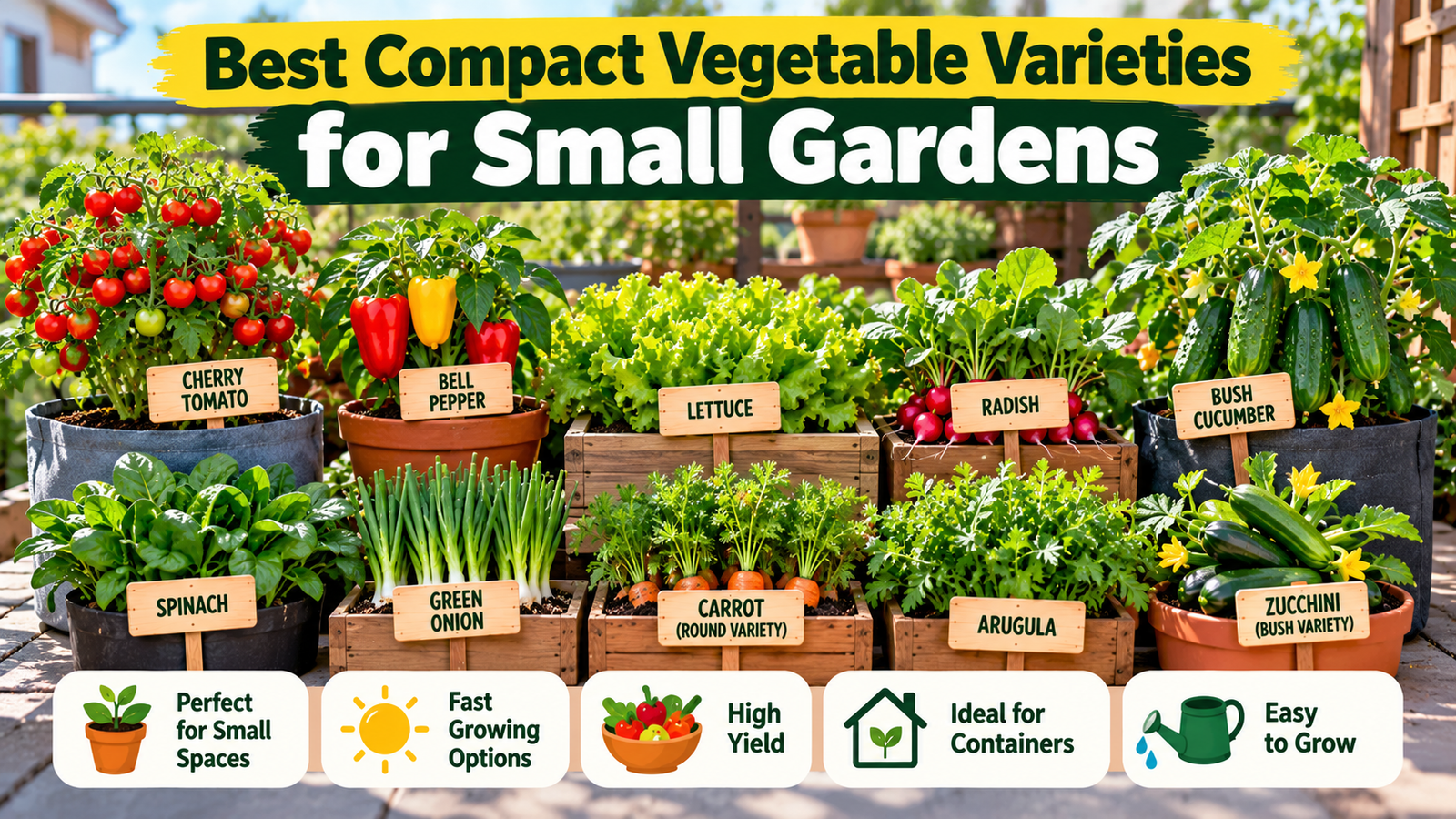
Having a small garden does not mean you have to give up growing fresh vegetables. In fact, with the right compact vegetable varieties, even a small backyard, patio, balcony, or container garden can produce a useful harvest.
When space is limited, I believe variety selection becomes especially important. Instead of choosing plants only by the vegetables they produce, I also consider the mature size of the plant and how it uses available space.
Why Compact Vegetable Varieties Matter
Some vegetable plants spread across a large area, while others remain relatively small.
Compact varieties are bred or selected to grow in a more manageable form. This can make them useful for small gardens and containers.
They can also make maintenance and harvesting easier.
Compact Tomato Varieties
Tomatoes are popular in small gardens, but traditional tomato plants can become quite large.
Compact or dwarf tomato varieties can be better choices for limited spaces.
Some can grow successfully in large containers when provided with sufficient sunlight, water, nutrients, and support.
Always check the expected mature size before planting.
Bush Beans
Bush beans can be useful for small gardens because they generally grow in a more compact form than climbing beans.
They can produce a good harvest without requiring a tall trellis.
This makes them practical for gardeners who want to use limited horizontal space efficiently.
Compact Cucumbers
Some cucumber varieties are more compact than traditional spreading types.
Bush cucumber varieties can be especially useful in small gardens.
If you prefer vining cucumbers, growing them vertically on a suitable trellis can also save ground space.
Patio Peppers
Peppers are naturally useful for small gardens because many varieties remain relatively compact.
Bell peppers, chili peppers, and other types can grow successfully in containers under suitable conditions.
Choose varieties according to your preferred flavor, fruit size, and heat level.
Lettuce
Lettuce is one of my favorite choices for small spaces.
It does not require a large root area compared with many larger vegetables and can be grown in containers.
Loose leaf varieties can be harvested gradually, allowing you to make efficient use of limited space.
Radishes
Radishes are another practical crop for small gardens.
They grow relatively quickly and do not require large amounts of space.
They can be planted in containers, small beds, or spaces between larger crops where conditions are suitable.
Compact Carrots
Some carrot varieties produce shorter roots and can be useful in containers or shallow garden beds.
However, the container still needs enough depth for the selected variety.
Always check the expected root length before planting.
Herbs and Small Greens
Although herbs are not always classified as vegetables, they can be valuable additions to a small edible garden.
Basil, parsley, coriander, and other herbs can grow in containers and take up relatively little space.
Combining herbs with compact vegetables can make a small garden much more productive.
Use Vertical Space
A small garden does not only have ground space. It also has vertical space.
Trellises can help certain crops grow upward instead of spreading across the ground.
Cucumbers, beans, and some other vining plants can benefit from vertical growing when the variety and support system are suitable.
Use Containers Carefully
Containers allow you to grow vegetables in areas where traditional garden beds are not possible.
Choose containers based on the mature size and root requirements of the plant.
A small container may not be suitable for a large vegetable plant.
Final Thoughts
Compact vegetable varieties can make a small garden surprisingly productive.
Tomatoes, bush beans, compact cucumbers, peppers, lettuce, radishes, and suitable carrots can all be useful choices depending on your growing conditions.
From my point of view, the key is to think vertically, use containers wisely, and choose varieties according to mature plant size rather than seedling size.
With thoughtful planning, even a small space can provide fresh vegetables for your kitchen.


