
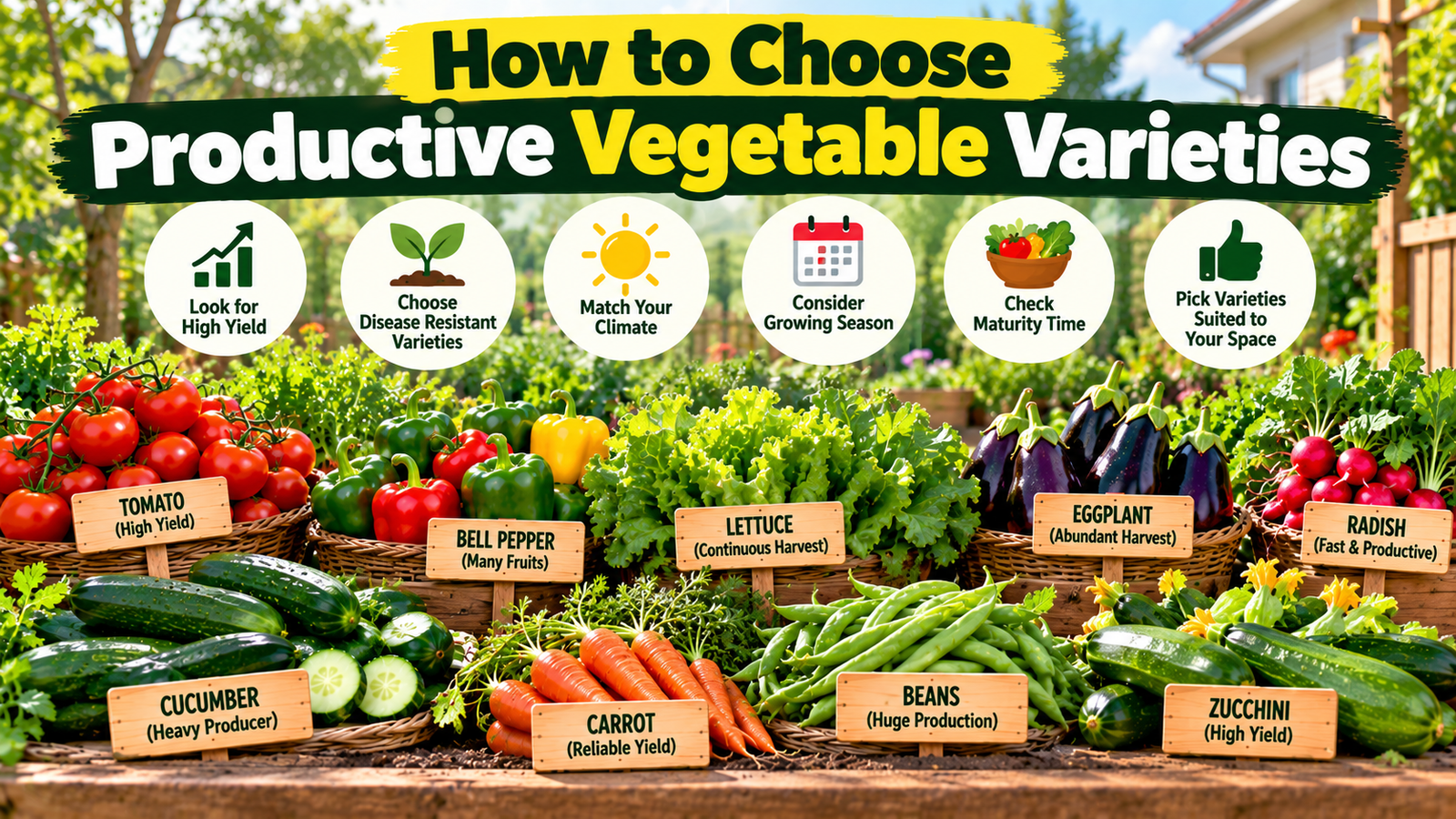
When I grow vegetables, I want my plants to produce a useful harvest. A healthy plant is great, but if it produces very little food, it may not be the best choice for the available garden space.
Choosing productive vegetable varieties can help you make better use of your garden. However, productivity is not only about the number of vegetables a plant produces. Flavor, plant size, growing season, disease resistance, and harvest period also matter.
What Makes a Vegetable Variety Productive?
A productive variety is generally one that produces a good amount of usable food under suitable growing conditions.
However, productivity can mean different things to different gardeners.
For one person, a productive tomato may mean many small fruits. For another, it may mean fewer but larger tomatoes.
Think about what productivity means for your household before choosing varieties.
Check Expected Yield
Some seed suppliers provide information about expected yield or general productivity.
This can be useful, but remember that actual harvest depends on growing conditions.
Good soil, sunlight, water, temperature, plant spacing, and pest management can all affect production.
Choose Varieties Suited to Your Climate
Even an excellent productive variety may perform poorly if the climate is unsuitable.
I always recommend choosing varieties that are known to perform well in your local conditions.
A variety adapted to the local environment has a better chance of producing a useful harvest.
Consider Disease Resistance
Healthy plants generally have better opportunities to produce.
If a variety has resistance to common diseases in your area, this can be a useful feature.
Disease resistance does not mean the plant can never become sick, but it can be one part of a productive garden strategy.
Look for Long Harvest Periods
Some varieties produce a large amount of food over a relatively short period.
Others may continue producing smaller amounts for a longer period.
I often prefer varieties that provide a steady harvest because this can be easier for a household to use.
Consider Compact Productive Plants
Small gardens need varieties that make good use of limited space.
A compact plant that produces a useful harvest can be more valuable than a large plant that requires lots of room.
This is especially important for container gardening.
Think About Your Family’s Needs
Productivity should be measured according to your actual needs.
There is little benefit in growing an enormous amount of one vegetable if your household does not eat it.
Instead, grow productive varieties of vegetables your family enjoys.
Grow Multiple Varieties
Growing several varieties allows you to compare them.
You can record how many fruits each plant produces, how long it produces, how healthy it remains, and how much you enjoy the harvest.
After one or two seasons, these notes can help you identify the most productive varieties for your garden.
Good Care Still Matters
Even the most productive variety needs proper care.
Provide suitable soil, adequate sunlight, appropriate watering, and enough growing space.
Overcrowding can reduce airflow and create competition for water and nutrients.
Use Succession Planting
Succession planting can increase overall garden productivity.
Instead of relying on one planting, grow quick crops in stages.
Once one crop is harvested, another suitable crop can take its place.
This can make better use of the growing season.

Final Thoughts
Choosing productive vegetable varieties is about finding plants that produce a useful amount of food under your specific conditions.
Consider yield, climate suitability, disease resistance, plant size, harvest period, and your family’s preferences.
From my point of view, the most productive garden is not necessarily the one with the largest number of vegetables. It is the garden that uses its available space wisely and produces food that the household actually enjoys.
Try a few varieties, keep notes, and compare results. Over time, you can build a reliable list of productive vegetable varieties that work especially well in your own garden.


